About sixteen years ago, I met him for the first time. My trainwreck sibling brought home this adorable puppy he had no business adopting because he had not one thing in his life that wasn’t a mess. I was furious at my sibling – he didn’t even take care of himself, how could he drag
Read More
April 16, 2012
We’d recently taken a much needed break to spend a few days with friends and a week without in Hawaii for our delayed honeymoon. I didn’t realize how very much we needed it but we were frazzled and dipped in less than happy sauce by the time we got on the plane.
I’d been stressing over financing the trip with points or miles for months, but honestly when it came right down to it, the effort of what used to be easy-breezy personal finance was just a burden on my overtaxed attention meter. I just couldn’t do it so we booked the flights, lucking into a sale, and put it on our card that we’ve been concentrating on building points for. It was expensive.
Transportation alone cost:
$550 for rental cars
$2300 for airfare
= Total, $2850
I thought we’d see some real savings not going to Australia…. whoo, boy. Not so much. And the food, oh my gosh the food. It was one, fannntastic. But two? Oh wow. I actually stopped keeping mental tabs on the spending because I needed to be able to enjoy the trip. After all, spending quality time together and stuffing our faces were the primary reasons we went! Boy, did we. Stuff our faces, I mean.
 |
| The requisite umbrella drinks on our first night in town! |
 |
| The most amazing bouillabaise I’ve ever seen – or eaten. That bread was a foot long, btw. That’s a lobster tail you see there. Next to the largest prawn I’ve ever consumed. Next to the best crab legs. Ever. |
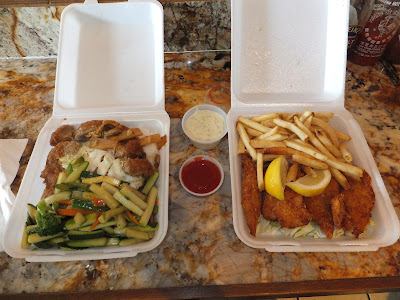 |
| Plate Lunches! A loco moco for her. Fried fish, chicken and pork with fries for him. |
 |
| Luau appetizers. Pineapple, poi chips, sashimi. |
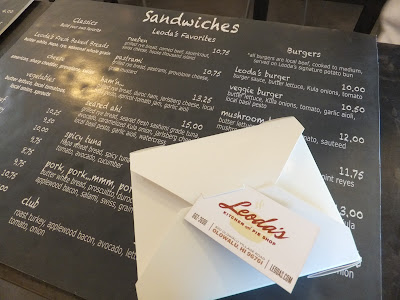 |
| Lunch at Leoda’s. Leave your heart (and most of your cash). Absolutely delicious. Definitely pricey but oh, so good. |
 |
| No vacation would be complete if I didn’t find a stray to pet! |
 |
| The famous Black Sand Beach – the sands were amazing. There is a big layer of black rocks; then really grainy sand. |
 |
| Yet another gorgeous beach on the road to Hana |
Sadly, I spent most of the trip down with a virus, apparently I’d been pre-infected or something so we were forced to keep our activities to a minimum. Bummer. It was still beautiful and the food was amazing but I’d really like to call a Calvin-and-Hobbesian do-over!
An interesting thing about Maui, I noticed, was the assortment of resorts and timeshares populating the coast. We meandered through a few of the semi-local areas on our own looking for more hole in the wall, less-touristy places to eat but pretty much everything catered to tourists if you were a reasonable distance from the coast. A local real estate office posted the listings for the timeshares currently available in its windows and of course I had to run over and look. It was incredible how much they were going for.
The place we stayed at simply wasn’t a luxury location or business, which was fine considering we only booked several months out so the booking agency couldn’t get us into anything nicer, but I couldn’t believe they’d sell at nearly the same pre-owned rates as the Westin or the Hyatt down the road. I guarantee you that the quality had to be much better at the places down the way. Our concierge had the gall to tell us our trip “wasn’t a honeymoon if the wedding was 5 months ago.” There’s some service for you. While I’m not overly precious about the trip myself, that was downright rude. If a guest was sensitive about it which frankly, given the fact that had we tried to honeymoon after our wedding and cancelled because of my mom’s death, I would have been … well, lucky for him, I was in vacation mode and my claws had been left at home. I’m just shaking my head over his need to go out of his way to be rude rather than just shrug and move on.
PiC and I had a fun debate over the cost of a timeshare and real estate in Maui. A driving tour guide told us that one piece of land (2 acres) plus a house was going for what seemed like a reasonable amount compared to the Bay Area: $400,000. You simply can’t get that kind of property here and I’ll admit to a moment of sheer insanity – what if we got a second home in Hawaii!?
……
Yes, ok. I had vacation brain. Right, we don’t even have a first house.
Plus, the cost of eating there had nearly given me a heart attack. I abandoned PiC in one grocery store because I’d nearly frozen to death while he ooohed and aaahhhed over the prices like we were in a zoo admiring otters do backflips. With cereal costing anywhere between $7-9/box, milk running $8/gallon, fruit $2/piece and up, it was hard to blame him but I didn’t go to Hawaii to become a Popsicle in their refrigerated section.
Anyway, housing – COLA was incredible. And while property tax was purportedly very low according to a couple of friends, cost of living for everything else remained skyhigh. Gas prices are actually higher than in the Bay Area by 10%. So no, a second home is everything firmly on the side of insane. It was funny to dream for a minute though. I just got suckered in by the idea.
Our two budget-busters were the luau and the really nice dinner in Paia. Luaus are, no kidding, pricey as all get out. We definitely ate way too much. And our friends recommended a fantastic seafood restaurant so I saved all my seafoody wishes for that restaurant and ate until I could hold no more. It’s embarrassing how much that food cost, actually, I couldn’t believe that it could run so much. But, as our dear friend who sent us to this timeshare texted us, “you only have a first honeymoon once!”
Yes, I burst out laughing. No, I didn’t text her back: “first?” That text is my justification for a do-over. 😉
It was a lovely trip. I had to let my hair down and in fact, let it wave free because I forgot my hairbrush. PiC had no qualms about being seen with me in public like that. He’s always been good about embracing messy-mussy-me. We had fun. It was a little bittersweet, remembering why we are still doing it out of order and still haven’t celebrated with family and friends. But it was good, reconnecting, rediscovering the world, and doing really really stupid things together like eating so much pork at a luau that neither of you can walk without pain. We deserved each other that night, and probably always.
April 13, 2012
TeacHer Finance’s attempts to find her frugal again had me laughing over my similar attempts to find my own sanity, financial and otherwise.
I was just chastising myself the other night for craving some really lovely luggage as shared by Feather Factor here. That was after wanting to book a pricey Michelin star restaurant for a surprise for PiC. That plan was junked, btw, because it’s nearly impossible to get a reservation and he’d gone and bought himself concert tickets. Then there were sales. Lots of sales. Ignore. Never mind the new dog bed. Rental cars, hotel rooms, more travel for other obligations.
Clearly my brain’d gone, just back from a trip (pictures to come) where the cost of living was astronomical, I think my impulse control on spending and being sensible had just gone kaput. As usual, this mouse was fed a cookie and, and, and ….!
Anyway, I talked myself off that particular tower when I remembered what kind of traveler I really am: prone to dropping/tripping over/leaning on/pushing over things, going into dirty dusty outdoorsy or urban places, business traveling or back-to-home traveling, not glamorous destination vacationy traveling. That’s not the sort of person who has gorgeous luggage! That’s the sort of person who stuffs up a duffel and a pack and rolls on out the door having forgotten two essential things. (Five, this last trip.)
Aspirationally I’d love to be that fabulously coiffed, trimmed traveler with the good shined up luggage, I mentally shop like Sarah (Paranoid Asteroid) but at the end of the day, we both know that, unless someone else is doing up my hair and scrubbing out the stains in my cargos that I just dumped PiC’s coffee all over, as you do before a five hour road trip, I’m not going anywhere as anyone’s pretty little lady.
Nor will I be any kind of a power careerist simply because I’m dressed to the nines. If I am. I’m doing well just to be not-terribly-mismatched during the work week but as that in itself is a chore, I often find myself reverting to trying to buy a sense of style and fashion through the insights of the petite fashion bloggers.
Admittedly, I might succumb to a sale this weekend for a staple piece or two but the best part of valor may really be to shut off the valve of spending entirely and not even try this halfhearted resistance. We all know it barely works on me.
Besides, I have bigger things to save for, like Comic-Con!
April 7, 2012
As our feet feel like they’re just touching the ground, we’re back off to the races!
We have a brief day and a half trip planned to visit family for Easter which, though we’ve known about it, we’ve had no time to get the prep done ahead of time requires: a car wash, a dog wash, a dog’s laundry washing, a cooler packed and meals made ahead all in the span of 3 hours this morning. Also, still need to buy hosting beer for the friends who are kindly offering us a room so we don’t have to stay at a hotel.
While I love the idea of catching up with a friend I’ve not seen in 4 years (but we didn’t know each other that well) our husbands have never met so a tiny part of me wonders, is this a great idea? Perhaps paying 25,000 points and a $50 pet fee might have been worth the quiet and peace of mind at the end of a long road trip ….
We need a gift to send back to SoCal with PiC next weekend for our really good friends so that has to be done now.
I have to send a set of books back to SoCal to another friend, so just remembering that I need to pack that now to see if I can’t send it back with Easter family to get it all the way back home. Spare PiC the extra baggage next weekend.
A friend’s wedding is at the end of the month: we missed the booking date for the blocked room rates so I had to get online to see what the extra cost was. Found that the “savings” weren’t, really. Booked using points instead as it fortuitously turned out that there were rewards rooms available. We’ve been bleeding cash of late. This helps.
Their gift: I spent two hours on the registry last night agape and aghast. Finally placed the order this morning as I was determined to check the gifting off the list. Found a combination of things that were reasonably good quality and still affordable without totally breaking our budget. Funded half of it with my Company Holiday Gift Card. Thank goodness for gift card hoarding and not using them on myself anymore. It should ship direct to them and arrive in advance of the wedding. (Two and three hundred dollar serving ware pieces? For students? I … don’t even know.)
It’s nice to get most everything out of the way but it feels like a whooosh of compressed air being let out all at once. LOT of pressure. Still, I will be grateful not to be worrying at the last minute about it, I know. This month (year/life) will only get busier as we go along.
And it’s going to be hot where we’re going this weekend. So very very excited to be warm. You have no idea how much I’m looking forward to that. I am jigging.
April 4, 2012
Our dear old Doggle, our canine companion of nearly a year, is now officially spoiled within a inch of his life. Nearly by us, mostly by our friends. Our friends lost their own beloved pet not too long ago and asked for the loan of Doggle when we traveled to fill their empty home for a little while, which we were glad to do as he looooves them.
We’ve now figured out why: the kids not only feed him treats hand over fist, he doesn’t just get a yard to romp in, he gets to sleep on the furniture! *cue heart attack*
We were texted a photo of him stretched out on the sofa, bookended by two excessively happy kidlings. Honestly. New meaning to Barcalounger.
Of course now that we’re home, he’s bored and aloof and his old bed is too small. And smooshed. And boring. And Pic, feeling the sting of mopey dejected dog, is ready to bribe Doggle with Yet Another Bed. That’s right, his third bed in less than a year.
Shall we recap?
He’s gotten in the last 11 months:
A new home.
Two beds.
Leashes and collars.
A car.
Two toys he really loves.
All the health care he can stand (and then some).
Oh, and endless food, love and affection, road trips to see extended family and friends who dote on him. And far too many treats from zany neighbor and kooky older people who can’t help themselves.
Next year, he’ll probably get a house with a yard full of grass we’ll have to water and mow for him.
Does anyone want to say it? No? Lucky dog!
Obviously, pretty tongue in cheek “resentment” here, he’s a lot of work wrapped up in an adorable fur coat and it’s equal parts love and sigh.
Oil and Garlic has run into a much more sobering difficulty with her dogs that I’ve known very well back home in Southern California.
April 3, 2012
Once upon a time, I dreamed big for the future. Out of those dreams, I formulated a life plan wherein I’d be taking a professional health degree of some kind and a PhD, entering a white collar profession, and buying a home for myself and my parents (separate homes, mind) before the age of 30. After 30 was a little hazy, but I figured plotting the next 23 years was good enough. Also, two degrees and affording two homes was a tough enough nut to crack – I wasn’t ready to plot any more years.
This was before I knew the words “net worth” because, you know, seven years old, but you had better believe that the balance sheets did not include debt. I’d already been writing out the checks for the bills for my parents and knew how I wanted to set up my own budget when the time came.
You may notice, as my mother had, that I had made no provisions in those plans, for marriage or kids. As far as I was concerned, it might happen, it might not, I wasn’t planning on it or depending on it and figured it wasn’t terribly relevant to the trajectory of my career and money. That was a pretty unsophisticated understanding of how life and marriage works.
Clearly, I was bound and determined to have my own mind and at the time, that also meant keeping my own finances, separate and free. As the years passed, I saw too many bad choices made by one or another couple where there was a divide in the spender/saver continuum, even in my own family, or business decisions gone awry, especially in my own family, and I just couldn’t fathom living in that life.
“If you live in a community property state, not combining finances is just lying to yourself about legalities.” @practicalwed
So once upon a time, I might have disagreed with Meg. Despite my primary marriage example being the relatively healthy and supportive partnership my parents shared in which they had combined finances, I was still certain that I could keep separate finances in any prospective marriage and cope just fine.
Except I’d never coped with two separate systems for myself and my parents so I had no blueprint for a working system. I’d assumed it was only a lack of income on their part and need to control on my part that that didn’t work.
After several months of juggling our separate systems, the time has come to wish good bye to that once-loved independent money philosophy: PiC and I need to combine our finances. Between my OCD control tendencies and his laissez-faire attitude to saving versus spending, I now doubt that we’d get to our final destination in one piece. And we live in a community property state so, frankly, we are combined in the eyes of the law, whether we have combined or not. Entangled, like it or not. (Romantic, hm?)
It’s been as stressful being hands-off while we paid bills separately and waited for incomes to reach stasis as it was maintaining two separate sets of accounts for myself and my parents more than ten years ago.
We just don’t function very well managing our “own” money when we have such different views of it. Part of it is the actual management and lack of transparency. The system isn’t set up well at the moment between our paychecks and direct deposits.
And philosophically, he still viewed his money as his money and spent freely, resenting that an uneven amount of expenses were coming out of his pocket, while I viewed all the money as our money and saved to offset his spending, and resented his depletion of our budget.
It turns out that we need to literally be on the same page to think from the same page. Never thought that’d be the case but there it is.
Starting at the beginning, I evaluated all our expenses and income and set up the target amounts that we’d want in specific pots for our savings and spendings goals. Now, we just have to figure out which banks and which accounts to keep and which to cut out, then actually do it.
Married Life Posts:
Married Life: Benefits
Married Life: Mortgage Prepayment for Refinancing
Married Life: Blending spending styles and learning the art of compromise
March 19, 2012
In Donna’s Strategic Pizza, she shares her experience with the beginnings of the same phenomenon that I’ve noticed has crept into our own shared lives organically, but not comfortably, over the past year and some.
One of the natural effects of living with PiC has been that my normal levels of frugality and privations to make sure that ends are met are offset by extra spending where I normally would not have chosen it.
Left to my own devices, life is conducted Broke Student Style. I don’t eat out, I don’t buy anything I don’t need unless (or even if) the existing item is falling apart, I stay home all weekend, every weekend because I can be productive, learn, and monitor finances without spending money that way. I’ll buy gifts, frugally, but rarely are purchases for myself.
PiC looks at me crossways, wondering why I didn’t just stop and pick something up to eat if I’ve run 4 hours of errands and I’m exhausted. He wonders why I don’t go out on a sunny day to shop, plan brunch, or have dinners out with family and friends.
Not only does it not occur to me to do that instead of cheap or free options like taking a snack on errands, cooking at home or going to the park or hanging out at home and catching up, it actually feels like I’m going off the rails. I’m being foolish and wasteful, spending.
Our experiences have shaped us so fundamentally differently, he and I.
When we come home after extra long (14+ hour) days, I wonder: What’s in the freezer and fridge? What kind of meal can I throw together if I don’t already have one ready? I can defrost and put something together. Or: maybe I can just pass out and forget dinner.
His is: Let’s just get take-out and get that worry out of the way.
The last thing I want to do is add spending guilt to my fatigue. The last thing he wants to do is spend more time and energy at the end of a long and tiring day.
Now that my health is so largely exacerbated by exhaustion and our income isn’t scraping by penny to penny, month to month, I have to admit that he has a point. I have to keep reminding myself that the ledger doesn’t need to be the absolute first (and only) priority.
In the early months of our living together, it was incredibly difficult not to object every single time the subject came up. To keep the issue from becoming a point of contention, I tried to artificially restrict the number of meals and the cost of eating out. I needed to impose some limits to know that we weren’t going to spiral into an endless convenience spending cycle.
After many months of tracking our expenses, we’re still looking for a system that suits us, but we’ve come to an understanding. Some convenience spending is part of our lives as a freedom he’s accustomed to, particularly when we’re, one or the other, just too tired to scrape the meal together, but we limit it to those times when the fatigue threatens familial harmony. The amount is still more than I’m comfortable with but that’s to be expected; we can work on that. Meanwhile, I’ve been learning to let go of the wallet-anxiety a little.
This is a small step in the direction of living a mindful, purposeful, and ultimately, peaceful life.
Married Life Posts:
Married Life: Benefits
Married Life: Mortgage Prepayment for Refinancing
March 9, 2012
Balancing acts in adulthood
I’ve been enjoying the conversations over at Wandering Scientist on work life balance. As I teeter into my thirties, I’ve been examining some of the financial and professional choices I’ve made during this decade and reflecting on how effective those philosophies have been and whether they will continue to hold true for the upcoming decade. I suspect that life and money and career in my thirties will be just as interesting a trip, but beyond that? Well, so far I’ve been terrible at prognosticating so I’ll just leave it at that.
As for my twenties ….
These were absolutely the foundation years: completing the final years of undergrad, deciding to hold off on graduate school until I knew better what I wanted out of it, throwing myself into my career at full tilt while digging out of debt and then building up a nest egg. My approach to my career and my money was the same: more is better.
Philosophically, the natural, deeply ingrained, unthinking element was an intrinsic need to achieve something, a drive to have a discernable growth pattern, to do something that seemed tangible. I wanted to build a career, I wanted to have achieved something substantive.
The logical, considered, and reasoned plan was to aim for a position where my work-life balance wouldn’t be dictated by the company because I was highly placed enough where they didn’t care about niceties like when I showed up or how many hours I worked as long as the job was done well. Essentially, I wanted to achieve the ability to talk terms with the company I worked for as long as I was an employee.
***
In Oil and Garlic’s post, A Precarious Balance, she discusses the ignored constraints in finding work-life balance when your income doesn’t stretch to buying flexibility and help. She lists a number of things that one can do to earn or achieve more flexibility from her perspective as a non-manager with a mid-level salary in a HCOLA. That combination probably describes a fair number of us who simply don’t have the ability to buy out of the choices that we have to manage to run households and feed mouths, day to day.
Meanwhile, she notes: At my company, those in manager positions and above enjoy a higher autonomy. They don’t have to ask permission to work from home. They also have the money for nanny and cleaning help, something that my household has paid for but at a great sacrifice (and only temporarily). They can still enjoy many luxuries like massages, travel and dining out. True, they have greater responsibilities, too, and they’ve earned it. But their solutions often aren’t applicable to those those in lower income brackets. In other words, they can buy some balance while many people don’t have that same privilege.
I very much agreed. Having worked many years in retail and other similarly low-wage environments while going to school, I’d observed very early on the vulnerabilities of being in the middle and lower tiers of any organization. One typically has less negotiating power in terms of responsibilities, is considered more expendable or is less valued as an asset to the company, and blends in with the rest of the equivalent employees holding the same role.
In that position, an individual’s power, and the choices one would like to make for oneself tend to lie in the advocacy and kindness of an immediate superior and his or her ability to persuade at least one or more rungs above if flexibility isn’t part of the company policy.
***
In the long-term, that was far too slim a reed for me to rest my life and my family’s lives on, particularly when I had the additional concern of a chronic illness for which there were no immediate prospects for improvement.
Superficially, need and circumstance dictated that I simply earn a living but I was compelled to steer my career trajectory as steeply as I could, as early as I could, while building a strong reputation in my chosen field. My theory was that should I be derailed for any length of time, for any reason, that reputation would serve to smooth my way.
Cloud, of Wandering Scientist confirms, whatever choice you make to take a break for family reasons after you’ve established yourself, you’re usually starting from a better place:
Once you have kids, you can decide whether or not you want or need to ease up on your career, but whatever you decide, it will be easier to keep your career viable if you have a strong reputation built in your earlier years. Whether you keep working or take a break, that reputation will serve you well. I think that one reason I haven’t suffered from much “working moms are slackers” bias in my own career is that I have a sterling reputation for productivity- and have maintained it. But we are also actively recruiting someone right now who is coming back after about 5 years off with young kids. We actually sought her out and asked her if she was ready to come back, on the basis of having been impressed with her work before she took the break.
Details will differ a bit across industries but the basis makes sense to me – someone who had a solid reputation before taking a break would have a leg up on someone who hadn’t established one.
***
My personal net worth has gone from -$50,000 in family debt to around $100,000 in assets over the course of nine years in addition to paying for all living expenses for a family of four. While it’s no great shakes, it’s certainly a fair start at a real financial basis with which to start a family.
I haven’t taken a break yet, and I don’t know if and when I (or we) will decide that it’s time to, but right now, I’m in a strong building phase of my career and striving for higher earning power. It’s only partly a joke that I’m trying to outearn PiC before the end of this year. That’s partly ego, and partly practicality. If I’m the higher earner, and we start a family, there’s a stronger case for him to stay home with the kids! 😉
In the end, my choices throughout my twenties were tailored to setting the scene and creating opportunities for freedom and better choices in the future.