About sixteen years ago, I met him for the first time. My trainwreck sibling brought home this adorable puppy he had no business adopting because he had not one thing in his life that wasn’t a mess. I was furious at my sibling – he didn’t even take care of himself, how could he drag
Read More
April 1, 2010
Time to face the music …..
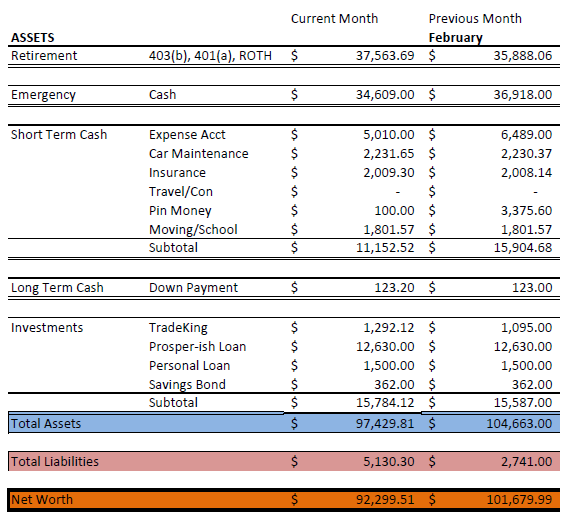
Most notably, I’ve dropped out of the six-figure club in a big way.
1. The car: $8250. I don’t count it in the asset column because it’s a depreciating possession. True, I could actually sell it for more than I bought it for (verified by the fact that another car buying friend’s market research) but I don’t intend to turn around and sell it and have to buy yet another vehicle. I have the cash, but for the sake of full disclosure, I’m including the upcoming insurance in this total because I pay for the full term in advance.
2. Moving expenses: around $2000. Again, I included all the currently due and upcoming charges on my credit card now. No creating a false sense of security for me, thank you. Never mind that they’re reimbursable, until the money is in my account it doesn’t count.
3. I have multiple outstanding invoices for around $1500. Again, I don’t count those as cash in pocket until it’s actually in my pocket.
I’ve made a few changes in my accounts
Since the Tax account was cleaned out for the car, I’ve changed it to Pin Money for now. Essentially, miscellaneous.
Moving Money might permanently change to School Money, but we’ll see if I can get any financial aid when I restart classes again. I’m taking a quarter off to concentrate on work. That money might be donated to insurance and maintenance.
I’ve been ignoring losses and gains in the TradeKing account but there’s no good reason to – after all, I track the gains and losses in the retirement accounts.
Cash flow looks like blood flow
My transaction log shows that I’ve spent about $11,000 this month against an income of $2,700. No debt (except to myself) was created so that was all saved money rushing out the door. Painful.
Finally ….
I could really use a paycheck by the time I’ve paid off the credit cards. They don’t come due this month, I’ve just got them tallied in because the charges are posted to the account; the cushion will hold a little longer. By the time charges are due, I’ll have a couple checks under my belt. And then we’ll see how the new dual-household/single income budget works. (“DHSI” as the new acronymic moniker? Not cute at all.)
March 31, 2010
Most of the move went fairly well except for some packing fails:
1. I absentmindedly packed the moving documentation. In the boxes I was shipping. FAIL.
2. Discovered that the moving guys grabbed my separated out clothing for my first two days of work and packed it into the wardrobe box. FAIL.
3. I’d meant to ship my heavy coats so I could pack other stuff in suitcases but didn’t pick up the dry cleaning in time. Had to pack both coats in checked luggage, leaving almost no room for anything else. FAIL.
4. The company never bothered to tell me they’d delayed my shipment by two days for delivery on the day before I start work. FAIL.
5. I’ve spent more than two hours on the phone with them trying to get copies of my paperwork via email without telling them I plan to use it to file a delayed service claim. FAIL for wasting time.
6. They contracted with an outside company to expedite delivery on Tuesday instead of Wednesday – that company called me and tells me they won’t deliver on Tuesday and won’t bring the shipment indoors. EFF THAT. I am not carrying 500 lbs of boxes upstairs by myself. Sicced my moving company that’s already in the doghouse with me on them.
7. I had to spend almost $200 on a few essential articles of back-up clothing in case they don’t deliver my clothing on time. See point 2 where my fail COULD have prevented this situation. The clothes will go back if I don’t need them this week. [But they’re .. so soft.. and pretty …. ] And btw, the fact that it costs that much for clothing that will fit properly is disgusting.
On the other hand …
1. I have my car, paid for, registered, and gassed up.
2. I have my first day information.
3. I have my commute planned for the first two days during which someone volunteered to show me where free parking is.
4. I managed to be polite over the phone every time with those idiots so they’ll never see the claim coming. They can’t obstruct me when it’s too late.
5. I did get a sheaf of 40% off regularly priced items at Banana Republic for purchases made on Wednesdays in stores. I’m saving that in hopes that a pair of trouser jeans in my size is still available in-store next week. Using that coupon and a gift card redeemed from my Citi Thank You points would be a great way to save my clothing budget from the cost of an extra pair of good jeans ($90- regular price; sheer insanity).
6. My claim letter is already written, proofed and awaits final additions should anything else go wrong with my delivery.
March 30, 2010
My experience with Peninsula life, and canvassing people who live in the specific area that I’ve moved to, all said: get your own car. While I could have borrowed a car for most simple runs, that car is a manual transmission and I’m not comfortable enough in it yet to drive without a whole lot of adrenaline-nervosity. (I don’t know about y’all, but the fear of hurting someone else‘s car is nerve-wracking.)
On bad joint days, I would never be able to handle a manual. They don’t happen as frequently as before but when they do, I’m out of commission.
Stacked with the managerial duties that will call for unpredictable early mornings and late nights, I don’t fancy relying exclusively on the three-five transfer public transportation option. There will be times that it works out, but not always.
Don’t get me wrong: I love the lower overall costs of commuting via public transportation and did it for nearly five years in a region that isn’t known for good pub trans. But after creating a whole spreadsheet comparison, I’d either have to add 20-30 minutes of bus time ($) or drive half the round-trip commuting distance just to get to a transit station and add the cost of parking ($$). All told, I’d be spending just as much on transit as my driving commute would cost, and would not be reducing my driving footprint (that’s a terrible mix of terminologies).
Outside of the work commute, there are very few things that are within walking distance (less than 2 miles) and even when it is, the skies have been known to open up unexpectedly halfway through. And the wind blows the rain sideways. I’m a SoCal girl! I’m intrepid but you understand that I don’t have the luxury of changing multiple times a day to stay dry. We have to be a bit more life-practical than that.
As for the money…..
The car purchase will cost me $6800 out of pocket and another $900 for registration and sales tax. The insurance costs $550 per 6 months.
The total cash cost: $8250.
After using the tax money I’d saved and the tax refund ($5575), I owe my emergency fund $2675 and must add $550 every 6 months to my insurance fund.
It’s not the most frugal auto choice I could have made but it was a 6-year-old car in as close to mint condition as I’ve ever seen. That kind of quality is very hard to find in a used car in my designated age range.
I have a plan in place to recoup my Debt to Self through freelance work. If all goes well, I plan to do so in four months.
March 29, 2010
Writing about thrift and the essence of making the best of your life reminded me that it’s been two years and two months since my grandma died. She couldn’t be a physical presence in my childhood but she represented incredible strength and integrity that informed my developing character.
Seventy-five years ago, my beloved grandmother married into a wealthy (in name only, at that point) family with only her bridal money, wedding clothes and her wedding ring. Her father-in-law, a landowner, had gambled away the family fortune, and the clock was ticking on the call date from his last throw of the die. At the time of their wedding, he had less than three years to pay the price of the final debt or forfeit thousands of acres of unworked lands. His children despaired and gave up the land as lost.
Armed with no more than an 8th-grade education and the instinctive determination to reclaim her new family’s property, she rolled up her sleeves and set about creating wealth from the lands. She directed my grandfather in his new duties, walking out the land each day until she was fully satisfied that she knew the terrain down to the last bit of soil, and made her plans.
She contracted out one-half of the land to farmers who could only afford to rent the use of the land, third world sharecropping, with specific terms – they were responsible for their own equipment and maintenance and in return for the use of the land, pay a set percentage of their yield. Her personal cash was strictly budgeted for her own operations on the rest of the land and storage facilities. Not only did she intend to make an income from the land, she meant to keep the entire operation a secret from the debt-holder hundreds of miles away. Her family knew but expected little result. “Too much work, too little time,” they said.
She didn’t just pay people to work the land, she worked it herself every single day. Growing, processing and storing rice over the course of multiple growing seasons, she guarded against word getting out that she would have rice to sell, and sent Grandpa to keep up the ruse by asking for short extensions on the final loan due date whenever he paid an installment.
When the deadline loomed, she sold all the stored and newly harvested rice.
On the final day, my grandpa’s eldest brother sat down with the banker to whom they owed the debt for the formal title transfer. Instead, Great-Uncle unpacked a suitcase of cash. The man was stunned. After his departure, she turned around and handed the title and deed to her equally shocked father-in-law.
To his credit, he tried to make her take the title. As far as he was concerned, she had rightfully earned every penny that bought back the land, and he insisted she was the new owner. And as was typical of her, she refused, agreeing only to take an appropriate fraction of the land if the rest was parceled out evenly among all his children.
Honor, Duty, Family, Birthright.
She lived her entire life by those watchwords. She raised nine children, fostered dozens of relatives, stood firm when her family and neighbors were caught in the middle of the war, buried a son, supported a son-in-law imprisoned for 15 years after the war, buried her husband, and continued to farm well into her 80s. The woman never blinked in the face of adversity; she served it hot tea and a freshly cooked meal. And a well deserved lecture, if need be.
Fun side note: when she was 82, she ambushed the wildcat who’d been raiding her outdoor kitchen in the middle of the night. She might have been 80 pounds soaking wet, but that never stopped discipline in her house. A whack across the nose, a firm tie-up in the corner of the kitchen so he’d keep until morning, and her poor housekeeper nearly had a heart attack when she inspected the “stray dog” that Grandma had captured. So her eyesight wasn’t great anymore at that age, but is it any wonder no one ever sassed her twice?
Sometimes I wonder what she would have been like in our modern world.
_______________________
March 28, 2010
for Postcards is Alli!
Congratulations and thanks to everyone who participated!
March 27, 2010
Girl Scout: “I think you should buy these cookies, sir! They are the healthiest!”
Friend: [thinking, are you calling me fat?] “Thanks but I’m buying these for my mom. She doesn’t really care about healthy stuff.”
Girl Scout’s mom: “Oh honey. No one cares about health, that’s not the way to sell them.”
Girl: “What happened to the toilet paper?”
Boy: “It’s not there.”
Girl: “You used it up?!?”
Boy: “No, I took it out.”
Girl: “What?!?”
Boy: “Look, I can’t keep all the stuff you keep adding to the pile…!”
Girl: “But it’s just one…!”
Boy: “The point is, if I keep all the stuff you keep stashing in my car…”
Girl: “It’s just one roll of toilet paper!!!”
It’s true, darlin’, ever seen Hoarders? You don’t want to be a Hoarder.
Driving home on good old SoCal freeways the other day, I encountered 4 speed racers (drivers in wee rice rockets frenetically changing lanes at 90 MPH), a dozen bikers one of whom popped a wheelie for half a mile in the fast lane, a car that had accordianed itself against the car in front of it, a fire, and a disabled vehicle/sitting duck right in front of a major interchange. Talk about a danger zone!
_______________
Giveaway:
Mrs. Money is having a $100 Giveaway at her blog
.
March 26, 2010
That’s a little misleading. It’s just that my sense of reality lags behind .. y’know, reality. It hasn’t quite sunk in all the way that I’ve finally left home. Actually that’s not true. It’s there, but I’ve only let myself mourn a little bit at a time. Full scale emotional acceptance will just have to wait – it’s too hard to get everything done while fretting about leaving my family, my home, and my workcave.
I said good-bye (for now) to my dogs who have no inkling at all that this is a huge step. /heart breaks a little/
My hometown friends evidently didn’t take me seriously when I said I was starting a job on April 1st in the northerly part of the state as one of them was surprised I’d left already. “What, no good-bye sendoff??”
*tired, grouchy, overwhelmed me says: If you wanted to see me before I left, you should have said so. The people who cared did say something and we saw each other. And if you thought I was going to organize my own send-off amidst the gazillion things I had to do? Chyeah. No.* So far as most friends and family are concerned, I’ve quietly slipped out of their midst.
I made a decision on the car front. More to come …
I’ve been actively pursuing freelance leads to supplement my income. Examples of my work have earned me a quick pass to the front of the line for one job. I hope we can come to an agreement as it would make at least a couple thousand and make up the difference in my spending of late. Wish me luck!